
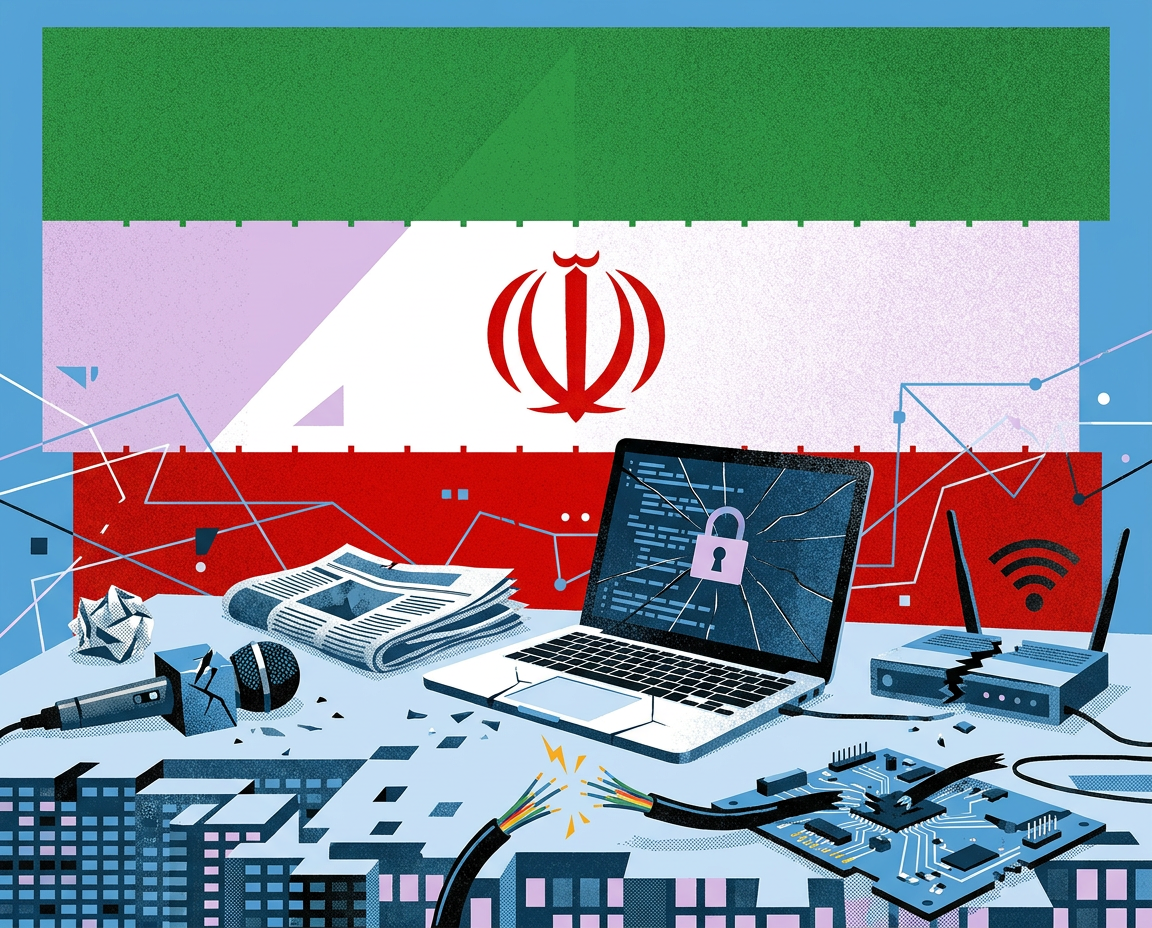
On the occasion of World Press Freedom Day, press freedom, which has been declining worldwide and across government structures for more than a decade, worsened in 2025, with no sign of changing course so far in 2026. Closely tied to these trends is a 15-year decline in internet freedom, as both authoritarian regimes — as well as a number of democracies — have been increasing their control over digital spaces (see our aggregated data resource). Press freedom and internet freedom are interconnected. For example, journalists who use online environments to bypass conventional press censorship are being prosecuted; independent media’s access to country-specific domains is being blocked; and certain websites and social media platforms are being filtered by governments.
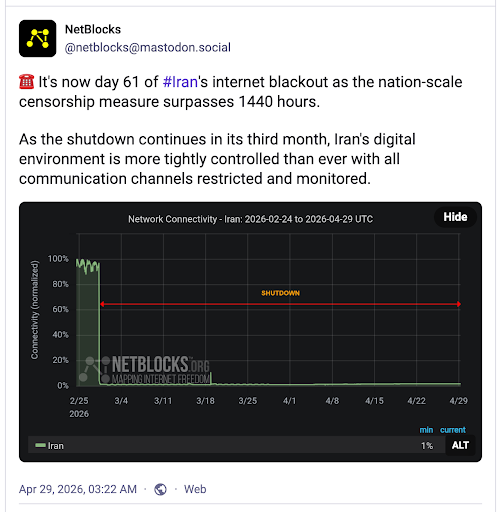
Against this backdrop, Iran emerges as a prominent example of decline in both internet and press freedoms. It serves as both a distinctive case marked by its own intricate challenges as a country and a microcosm of the global threats to press and internet freedom. As of April 29, 2026, Iran has been offline for 61 days: “the longest sustained nation-scale internet blackout … tracked in a highly connected society.” Going far beyond mere technical disruption, this is a collapse of the information environment, unfolding in the context of a war — though active hostilities have since temporarily eased — and violating the fundamental right to access the internet.
Collapse of information access inside Iran
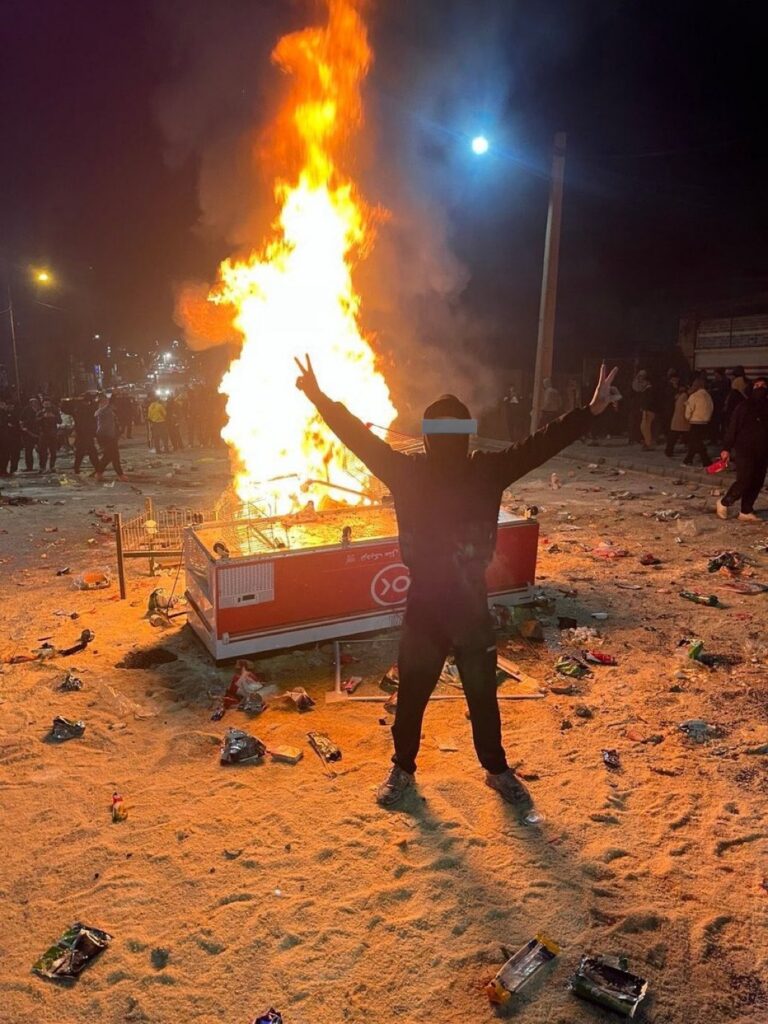
Journalism and internet access have been subject to the Iranian state’s severe control since the Iranian Green Movement in 2009. Since then, authorities have turned internet shutdowns into a routine practice during political crises, such as during the deadly 2019 Iranian protests and the June 2025 Iran-Israel conflict. During an internet blackout amid the 2026 January protests, a reported 7,000 people were massacred, with over 11,000 additional deaths under investigation.
The February 2026 blackout was deemed “near total” because online activity is restricted to domestic domains via the National Information Network (NIN), the state’s localized internet project, forcing users to rely on unconventional methods to connect to the global internet. Traditional bypass methods such as conventional VPNs are largely ineffective, and emerging tools like satellite services and underground networks are often scarce or expensive. The legal landscape is also becoming more punitive: VPNs were outlawed in 2024 and the possession or distribution of Starlink was declared illegal in October 2025. Beyond the profound disruption to daily life, Iran’s internet restrictions also result in severe limitations on newsgathering and reporting. Reporters who do not “echo the government’s narrative” are often forced to use unsecure, state-monitored domestic messaging apps. The use of these apps endangers the private data of both journalists and their contacts, significantly increasing the likelihood of state surveillance and potential arrest, resulting in pressure to engage in self-censorship.
Tiered access and structural inequality
A tiered system imposes heavy censorship on most people while granting select individuals and organizations unrestricted internet access, turning connectivity from a universal right into a privileged exception. Authorities use “layered censorship” tactics to block the general public and “whitelist” specific individuals by distributing “white SIM cards.” By law, certain professions, such as Iranian businesses, academics and journalists working for state-approved outlets, are eligible for this unrestricted access. In practice, however, these privileges are extended to hard-line politicians and lawmakers.
This leads to a major digital divide and unequal access to information: pro-government actors shape narratives while others are censored, and ordinary people must pay high costs just to stay connected.
A growing global information vacuum
Such disruptions to the information flow extend beyond local borders. In 2009, Iran enforced a ban on all foreign media journalists, preventing them from “reporting from the streets.” Since then, reporting from Iran has faced significant obstacles such as the imprisonment of journalists from major Western newsrooms, which has made many international outlets hesitant to maintain a physical presence in the country. As a result, foreign media coverage is rare, though there have been some notable exceptions.
Given the lack of a reliable, secure internet connection between Iran and the rest of the world, it is increasingly difficult to verify stories, complicating international news media coverage of Iran.
Misinformation, disinformation and AI-generated images
The closed internet system paves the way for a flood of misinformation, disinformation and broad uncertainty about the realities in and outside Iran. These efforts include a surge of AI-generated content — what experts call the first conflict in which synthetic visuals dominate — making it easy to produce dramatic but fake war footage. There are also fake and/or edited satellite images claiming damage to military bases and deepfakes of political leaders used for propaganda. This content spreads through coordinated networks linked to Iranian state actors and amplified by certain global media actors, such as Russian and Chinese media, and bots to push specific narratives. At the same time, platform monetization structures — particularly on X — create incentives for the mass production of viral misinformation, while verification mechanisms, including AI chatbots, often misclassify fabricated content as authentic. To make matters worse, emerging tactics like “forensic cosplay” deploy pseudo-technical analyses to discredit genuine documentation of civilian harm, enabling the denial of real-world violence. While these efforts can exist even within open internet structures, a closed system makes it all but impossible for accurate accounts to compete with false ones.

Information control as part of a broader media war
In the context of the war in Iran, information control has emerged as a strategy for the other countries involved. In addition to Iran’s actions, governments and regulatory bodies in both Israel and the U.S. have implemented measures to manage narratives, restrict sensitive data and penalize reporting deemed unfavorable or dangerous to national interests, thereby undermining the media’s ability to report freely.
In Israel, information control has long been formalized through a legal system of military censorship backed by police enforcement, with reporters barred from publishing material deemed a security risk. Itamar Ben-Gvir, the Minister of National Security, has pledged “zero tolerance” for media violations, prompting investigations and detentions of journalists, including the obstruction of Ahmad Darawsheh.
In the U.S., FCC Chairman Brendan Carr has threatened to revoke broadcasters’ licenses for coverage of the Iran war, drawing criticism from free speech advocates. Pressure on the media has also intensified after U.S. Defense Secretary Pete Hegseth restricted press access in the Pentagon. The Intercept reported that the U.S. Central Command downplayed troop casualties and President Trump suggested that outlets spreading what he calls “fake news” could face treason charges.
As the conflict expands to neighboring nations, so does information control. The CPJ has documented a long list of violations of press freedom, including but not limited to nine journalists killed since the war began and at least nine media outlets damaged as a result of airstrikes. Stringent regulations have also been implemented in nations such as Iraq, Jordan and the UAE. In Kuwait, for instance, authorities arrested Kuwaiti-American journalist Ahmed Shihab-Eldin. He faces charges of “misusing his mobile phone, harming national security and spreading false information.”
What to do now?
In 2025 alone, at least 313 internet shutdowns were recorded across 52 nations (Our newly updated issue primer on the open internet covers the topic in more detail). Therefore, press freedom has never been less separable from internet access. When connectivity is restricted, journalism is constrained, information flows collapse and both national and global audiences are left navigating a distorted information ecosystem. The path forward in formulating solutions to internet shutdowns and threats to press freedom is threefold.
Bypassing digital isolation with technology. Traditional censorship workarounds like VPNs are increasingly limited by infrastructure shutdowns and app whitelisting, while satellite options remain costly and detectable. As a result, experts point to Direct-to-Cell (D2C), which connects standard smartphones directly to satellites, as a promising alternative, with groups like Access Now and WITNESS urging its development to prioritize users in crisis zones.
Protecting journalists and press freedom. The United Nations Plan of Action on the Safety of Journalists and the Issue of Impunity outlines key strategies to protect media freedom, including tackling digital threats, strengthening legal protections, combating Strategic Lawsuits Against Public Participation (SLAPPs) and establishing national systems to prevent and prosecute attacks on journalists. In highly restrictive states, protection must extend beyond the newsroom by supporting exiled journalists and enabling cross-border reporting. CNTI’s broader work on journalist safety underscores the need for coordinated approaches to these risks.
Supporting information resilience via community and education. Beyond legal and technological fixes, supporting a free press requires resilient information ecosystems, including greater awareness and decentralized networks like diaspora journalism, as well as global advocacy efforts such as #TruthNeverDies and World Press Freedom Day to sustain pressure on governments.
Share