
TL;DR
Explore Full Report
Overview
As of September 2024, about one in five people in the United States get news from individuals rather than organizations. This trend is even more common among younger people.
There have always been news sources beyond institutional legacy media. Zines, alt-weeklies and blogs have provided alternatives, as have publications serving immigrant, queer, Black and other minoritized communities. Somewhat more recently, YouTube inaugurated the current era of platforms. Still, the current swell of interest in indie media and the rapid rise of new entrants feel new.
This study aims to better understand who indie info providers are, and how they approach their role in the broader news landscape.
About This Report
Note on Terminology
There is no consensus on terminology, even among our interviewees. We primarily use the term “indie info provider” and sometimes “creator-journalist,” which was the term used in our survey and interviews. If anything, creator-journalists are a subset of indie info providers: they have journalism backgrounds and typically see themselves as journalists, even if they don’t use the term publicly. Both terms appear throughout the report to refer to the same group: “people who are working to provide verified factual information with a personality- or voice-driven brand that leverages the creator economy.” That definition encompasses a tremendous amount of variation.
Why we did this
According to our research, about one in five people in the United States get news from individuals rather than organizations, and it’s more common for younger people to get news and information this way. A glut of new platforms and technological tools also make it easier to run a solo or small info provider business.
Featuring individual voices over institutional brands has been paying dividends in terms of both audience trust and the flexibility to try out different formats, tools and platforms. Legacy media is paying attention to this trend and newsrooms like The Washington Post and ESPN are now partnering with indie info providers.
To date, research on this trend has largely focused on the broader landscape of content creators, including entertainers, politicians and other creators who do not necessarily focus on informing their audiences. And most research to date has focused on content sourcing and linking strategies. To enable a future for a plurality of fact-based sources that readers and viewers find relevant, our project sheds light on who indie info providers are, and how they approach their role in the broader news landscape.
How we did this
In partnership with Project C, CNTI recruited 43 adults in the U.S. to take a screening survey and chose 26 for a 60- to 90-minute virtual interview. CNTI selected interviewees to represent a range of professional backgrounds. This report is based primarily on insights from the interviews, with data from the survey as a secondary source.
In keeping with Project C’s focus, most interviewees were former journalists — but we prioritized interviewing people from non-journalism backgrounds, and we were able to interview science communicators, subject-matter experts and civic-minded community members without journalism experience. Throughout this report we call out contrasting examples that suggest larger differences between former journalists and indie info providers from other backgrounds. We also spotlight examples from indie info providers outside our sample, where relevant to point to the broader diversity of backgrounds and experiences.
In interviews, we asked participants about their backgrounds and motivations, audience engagement, their relationships with other indie info providers and legacy news outlets, platforms and algorithms, revenue and business strategies, and their view of success and satisfaction with their own work.
We developed codes using a bottom-up and iterative approach as themes emerged through the analysis. Code categories largely reflected the range of interview topics as well as the addition of the broader themes “freedom” and “small business owner.” These methods provide richness and depth; however, it’s not possible to generalize about the frequency of behaviors from these interactions, so we limit our use of quantitative terms to our interviewees throughout this report.
CNTI research and professional staff prepared this report. This project was made possible by the financial support of the Lenfest Institute and a second anonymous donor.
There is a growing mix of networks supporting what CNTI refers to in this report as “indie info providers” in the U.S. alone. To name just a few, Project C, our recruitment partner for this report, primarily serves former journalists building independent ventures; the Tiny News Collective brings together community members trying to meet their own community’s information needs; News Creator Corps trains creators from non-journalism backgrounds in media literacy; Listening Post Collective supports communities and community info providers; and the Evidence Collective supports health and science communicators with deep professional expertise. Many indie info providers are engaged with more than one of these organizations, emphasizing how diverse their professional backgrounds are — which makes it difficult to generalize about them.
CNTI sought to better understand this active arena of indie info providers playing increasingly important roles in people’s daily lives. What are their backgrounds, motivations, relationships with their audiences, revenue streams and strategies and their sense of their role in the broader news information landscape?
To offer a starting point, CNTI conducted a series of in-depth 60- to 90-minute interviews with a mix of U.S. indie info providers, defined as “people who are working to provide verified factual information with a personality- or voice-driven brand that leverages the creator economy.” The group was drawn from within Project C’s broad network, with an emphasis on hearing from science communicators, subject-matter experts and civic-minded community members in addition to the largely journalistic base. (We have also conducted a similar set of interviews with these types of providers in South Africa, which we look forward to reporting on soon.)
Among this set of U.S. indie info providers interviewed, we learned that they are:
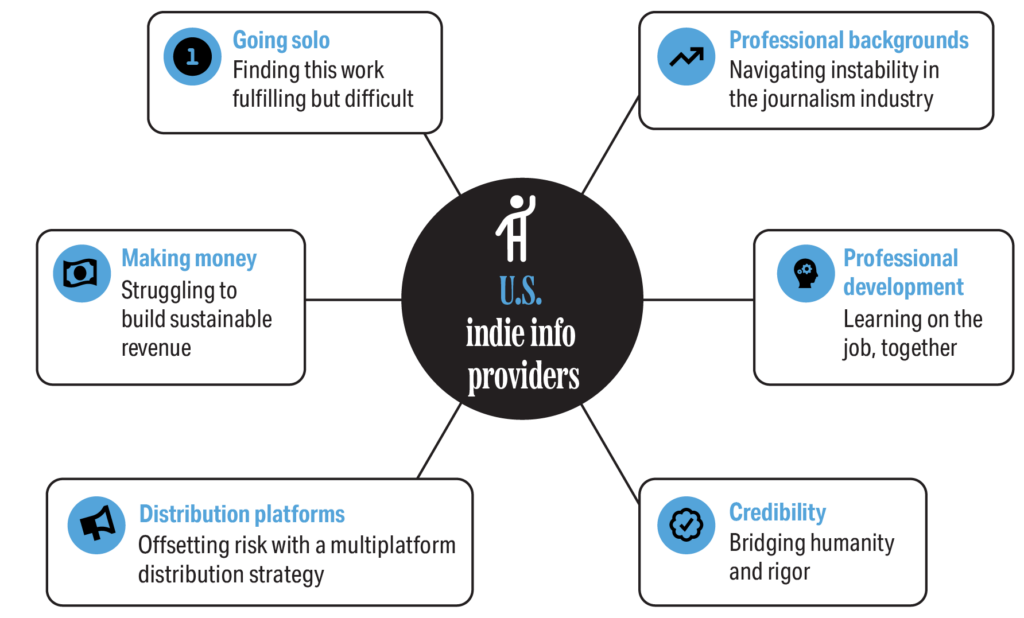
🧭 Navigating instability in the journalism industry
This cohort of emerging indie info providers is quite professionally diverse. Most we spoke to (19 of 26) had at least some experience inside journalism before becoming an indie info provider. For 10 of them, newsroom reporting had been their only career job. And while some former journalists chose to make their passion a full-time focus, the most common reasons for making the transition were job loss and field-wide instability. Non-journalists, on the other hand, largely started their indie project on the side of a full-time job. One thing they all share, regardless of background: a sense of mission that helps them stick with this work. Reflecting on how prepared they were for the transition, the 10 interviewees who had only worked as newsroom reporters largely felt ill-equipped for the realities of entrepreneurship; the 7 with no newsroom background largely want to learn more about journalism practices. But across the board, this group of indie info providers said their dream job can’t be found within other institutions. As one interviewee put it, “Unless I build the thing that I want to work for, it’s not going to exist.” Read more.
👥 Learning on the job, together
No matter what skills they already had, everyone described on-the-job learning as a major component of their current work. Less than half of interviewees (11 of the 26) had taken some kind of structured course. For those who did, it was primarily on business or financial skills. Instead, most learning occurs through trial and error as well as sharing among colleagues. As one interviewee put it, “The biggest teacher was either personal experience or chatting with peers.” Interviewees tend to learn from and with peers with similar backgrounds; nobody mentioned opportunities in adjacent fields such as the broader creator sector, open-source development or public scholarship. There was little if any indication of strong resource sharing with adjacent fields or even awareness at this point. Read more.
🤝 Bridging humanity and rigor
In contrast with legacy media, these indie info providers tend to marry authenticity with authority, with a very clear sense of their voice and the way they build credibility with their audiences. Offering markers of personal and shared experience such as ethnicity, parenthood or community engagement is critical to their work, particularly because “humans trust humans” more than institutions or machines. Rigorous ethics policies and transparent reporting techniques add value, but these traditional tactics are not enough to build a following. Interviewees are highly engaged with their audiences, getting story ideas and tips from direct exchanges and audience surveys. At the same time, this sort of engagement does not always translate to detailed knowledge about exactly who they are reaching. Much of that knowledge depends on their use of various audience software and analytics apps; some say it’s simply not a priority given all the things they have to juggle. Read more.
📊 Offsetting risk with a multiplatform distribution strategy
Most of the indie info providers we interviewed are on at least three distribution platforms, including newsletters, their own sites and a variety of social media accounts. They make platform decisions by weighing their preferred formats, perceived audience reach and perceived revenue potential. Many expressed frustration at the need to stay present across so many platforms. They’ve experienced platforms “nuking the reach of links” without notice, so it doesn’t make sense to put all their eggs in one basket. For some, there’s a tension between informing readers and viewers and paying the bills: the platforms that make it easiest to reach the most people aren’t always the ones where they make the most money. What flies largely under their radar is differences in how platforms are built and run. While indie info providers do not see LLMs as a major factor in distribution right now, some worry about them becoming competitors. Read more.
💸 Struggling to build sustainable revenue
It’s no wonder that indie info providers are stressed about their platform strategy: very few are making all of their money through this work. They share the same financial challenges as both legacy journalism and other small business start-ups. For former journalists, building a brand and monetizing their work often feels like a distraction from what drove them to this work in the first place. And less than one in three interviewees has a developed business strategy; instead, they’re “hoping it will become more financially viable.” How “hope” could translate to a more structured business strategy is unclear, though entrepreneurial skill-building and collaboratives are possible vehicles. Read more.
🧠 Finding this work fulfilling but difficult
Like early entrepreneurs in any industry, interviewees tend to work alone, and a lot – as one described it, “every waking thought” – dividing their time between working on content and working on the business. They keep at it because they find it fulfilling, and value their editorial and managerial independence. That said, nearly all would like some level of emotional support and help troubleshooting. Many do find that with their peers, but those who come from non-journalism backgrounds feel less supported in the current ecosystem. Many former journalists miss the day-to-day community they had working in larger organizations, but they are also pessimistic about the job prospects in legacy journalism. One thing that makes it possible to work alone, especially with limited time and resources, is access to technology. Still, they wish their tools were better integrated into their workflows to save them even more time. While many use LLMs for some tasks, these aren’t their most valuable resource, and they prefer specialized tools for most areas of their work. Read more.
“[If I could do it all over again], maybe I could have thought [out] the roll-out in a little bit of a smarter way to try to beef up my subscribers before I started … maybe done a teaser campaign or been more shameless about promoting myself.“
Acknowledgments
CNTI thanks Liz Kelly Nelson for input throughout this process; Amy Kovac-Ashley, Celeste LeCompte, Afrooz Mosallaei and Ben Werdmuller for their thoughtful feedback on this report; Jonathon Berlin and Kurt Cunningham for web and graphic design; Grace Nuri for logistical support and additional feedback; Angelica Ruzanova for support with transcription and data processing; and Greta Alquist for editing this report. This project was made possible by the financial support of the Lenfest Institute and a second anonymous donor. We thank all the creators who participated in this report.
Continue Reading
Share