TL;DR
Explore Full Report
From the public’s perspective, indie info providers may seem like a cohesive category. But indie info providers don’t necessarily have a shared professional identity, and broad networks of indie info providers are not yet well established.
To begin to understand this disparate group, CNTI worked closely with Project C, one of the first and largest networks of indie info providers, to recruit interviewees for this report. Project C interfaces with a tight network on Slack and reaches a broader set of indie info providers through their newsletter. Currently, their network largely consists of former journalists, who may not be representative of the range of indie info providers and their professional backgrounds. We prioritized recruiting people from non-journalism backgrounds, and we were able to interview science communicators, subject-matter experts and civic-minded community members without journalism experience.
Why and how we did this
Note on terminology
There is no consensus on terminology, even among our interviewees. We primarily use the term “indie info provider” and sometimes “creator-journalist,” which was the term used in our survey and interviews. If anything, creator-journalists are a subset of indie info providers: they have journalism backgrounds and typically see themselves as journalists, even if they don’t use the term publicly. Both terms appear throughout the report to refer to the same group: “people who are working to provide verified factual information with a personality- or voice-driven brand that leverages the creator economy.” That definition encompasses a tremendous amount of variation.
Why we did this
According to our research, about one in five people in the United States get news from individuals rather than organizations, and it’s more common for younger people to get news and information this way. A glut of new platforms and technological tools also make it easier to run a solo or small info provider business.
Featuring individual voices over institutional brands has been paying dividends in terms of both audience trust and the flexibility to try out different formats, tools and platforms. Legacy media is paying attention to this trend and newsrooms like The Washington Post and ESPN are now partnering with indie info providers.
To date, research on this trend has largely focused on the broader landscape of content creators, including entertainers, politicians and other creators who do not necessarily focus on informing their audiences. And most research to date has focused on content sourcing and linking strategies. To enable a future for a plurality of fact-based sources that readers and viewers find relevant, our project sheds light on who indie info providers are, and how they approach their role in the broader news landscape.
How we did this
In partnership with Project C, CNTI recruited 43 adults in the U.S. to take a screening survey and chose 26 for a 60- to 90-minute virtual interview. CNTI selected interviewees to represent a range of professional backgrounds. This report is based primarily on insights from the interviews, with data from the survey as a secondary source.
In keeping with Project C’s focus, most interviewees were former journalists — but we prioritized interviewing people from non-journalism backgrounds, and we were able to interview science communicators, subject-matter experts and civic-minded community members without journalism experience.. Throughout this report we call out contrasting examples that suggest larger differences between former journalists and indie info providers from other backgrounds. We also spotlight examples from indie info providers outside our sample, where relevant to point to the broader diversity of backgrounds and experiences.
In interviews, we asked participants about their backgrounds and motivations, audience engagement, their relationships with other indie info providers and legacy news outlets, platforms and algorithms, revenue and business strategies, and their view of success and satisfaction with their own work.
We developed codes using a bottom-up and iterative approach as themes emerged through the analysis. Code categories largely reflected the range of interview topics as well as the addition of the broader themes “freedom” and “small business owner.” These methods provide richness and depth; however, it’s not possible to generalize about the frequency of behaviors from these interactions, so we limit our use of quantitative terms to our interviewees throughout this report.
CNTI research and professional staff prepared this report. This project was made possible by the financial support of the Lenfest Institute and a second anonymous donor.
Even among this relatively small group of 26 interviewees, we observed some clear differences between those with and without significant journalism experience.
Most of the indie info providers we interviewed have at least some experience in journalism. Losing a job was the impetus for many, but not all, to go out on their own.
Out of the 26 interviewees, 19 have worked in journalism at some point. Four of the former journalists also have management experience in journalism, and five have worked in other fields. The other ten have primarily worked as individual reporters or producers.
One reason journalists become indie info providers is in response to structural instability across the journalism industry. As one person said, “This industry is the Wild West. I’m four [Wild West moments] in at this point … I feel like a veteran of that constant reinvention and also like I’m constantly at the beginning of my career, every time there’s a big change in how this work is made.” Another raised similar concerns: “I can see that the SEO agency is editing more than my actual editors. I saw this and thought, ‘I’m going to be extinct.’” Most of the former journalists had been laid off at least once in their career or had pivoted away from journalism relatively early in search of stability, like one person who failed to find a full-time job after several successful internships.
In addition to layoffs pushing them out of legacy journalism, indie info providers coming from journalism backgrounds also highlighted concerns about intellectual property and creative freedom. If they built a product with a clear personal voice inside legacy journalism organizations, they said, that product belonged to someone else. As one former journalist said, “Unless I build the thing that I want to work for, it’s not going to exist.”
For most of the former journalists, industry-wide instability was a direct reason for their indie pivot. Of the 19 former journalists we interviewed, 10 had been laid off from their most recent role, whether in journalism or outside it, and four were full-time freelancers adding a new component to their work. While freedom was a draw, it was not the primary reason for their pivot. Three other former journalists quit full-time jobs to start their indie venture and the last two launched theirs as a side project while holding down other jobs.
Among the seven indie info providers with no journalism experience, all but two started their indie venture as a side project while either working a full-time job in another field or receiving retirement income. That meant they did not face the same pressure to be profitable nor the anxiety of building a career in a field that has been contracting for twenty years.
Across backgrounds, indie info providers are mission-driven.
Every single indie info provider we interviewed is doing this work because they want to inform people. (That’s also built in to who we were seeking out, “people who are working to provide verified factual information.”) The sense that their work is important is one of the reasons they stick with it, even when it’s difficult. Their commitment to the mission is not the only factor that led them to this work, but it is an important factor. This is true across topics and audiences, although they also expressed a sense that the stakes of informing people varied widely by topic.
Creators? Journalists? Experts? Naming the field is still in progress.
When asked if they considered themselves journalists, 20 interviewees said yes, five said “it’s complicated” and a single person said no. These answers do not correlate with their professional backgrounds: both former journalists and non-journalists were uneasy with the title of “journalist.” Even among those who do see themselves as journalists, whether they use the title or not depends on the context. For example, one interviewee describes themself as either a creator or journalist based on who they are interacting with. For this person, the “creator-journalist” title still does not fully cover everything they do because they also write, edit, publish and manage a business. Another interviewee feels silly comparing themselves to “friends who are journalists who are war correspondents” because of the lifestyle content they cover, and described themself as a “lowercase j journalist” or “magazine journalist.” (It is worth noting that there are indeed some indie war correspondents. Bisan Owda reports from Palestine on Instagram and TikTok. Tim Mak reports from Ukraine on The Counteroffensive.) Quite a few indie info providers are hesitant to use the “journalist” title outwardly because they think audiences don’t trust — or like — journalists.
Indie info providers feel similarly about “creator” as a title. It’s both too broad — “creator can mean a gajillion different things” — and too narrow in that no indie info provider spends their whole day being creative. Some people also worry about the incentives associated with the “creator economy,” which rewards engaging content over informative content. As a result, they distance themselves from this term: “The creator economy can inadvertently draw people to maybe not the best version of themselves. … If professionally you’re out there trying to get personal attention, it just kind of makes you insufferable.”
For some, “expert” is a more comfortable label than “journalist.” Indie info providers know a lot about their subject areas — whether it’s a hobby, a geographic region, a professional area of expertise or a journalistic beat — and they communicate the facts clearly and well. In fact, some of them became indie info providers because legacy journalism covered their area either poorly or not at all. This is another reason the “journalist” title can be uncomfortable.
There is one area of near-consensus: almost nobody likes to call themself an “influencer.” That’s consistent with other research in this area.
The long-held firewall between the newsroom and the business side of legacy journalism makes going it alone harder for former journalists.
Of the people we interviewed, 10 had only ever worked inside the newsroom; the other 16 had either held management positions, worked in other fields or both. When we asked about the parts of the job they felt most — and least — prepared for, we saw clear differences between these groups.
Overall, those who had only worked as a journalist in a newsroom were more likely to say they were unprepared for some of the business and operations aspects, while those with other experience mostly said their prior roles prepared them to run a business. These skills include structuring workflows and deadlines, managing budgets and finances, and overseeing sales and marketing.
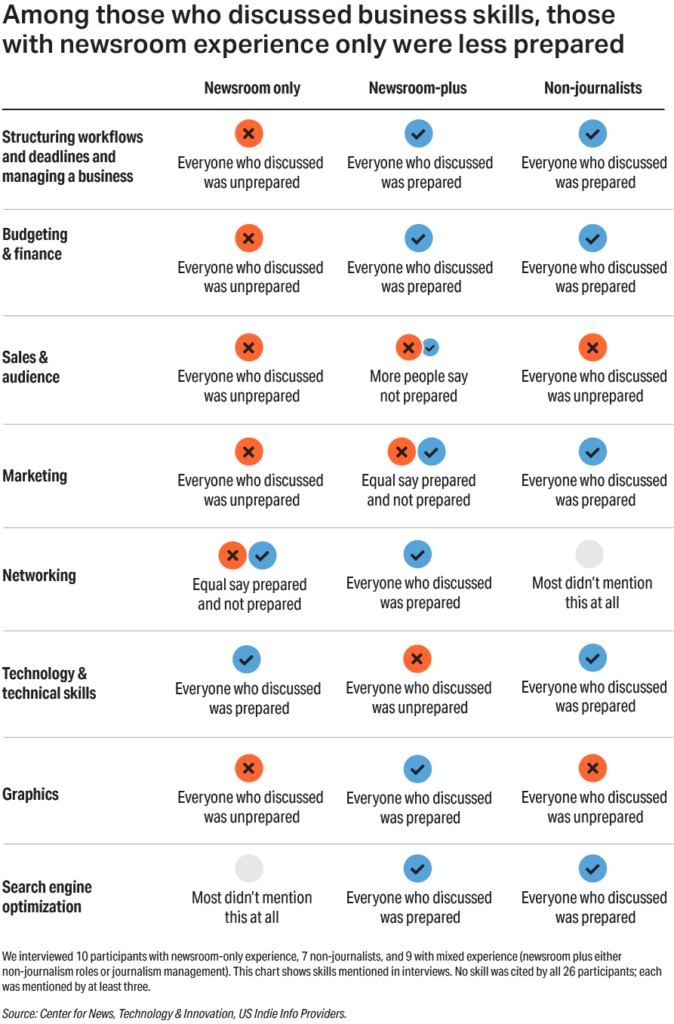
It is worth pointing out that the challenges faced by indie info providers aren’t specific to journalism. Many who move from holding a specific position inside a larger organization to doing their own independent work run into similar issues with steep learning curves around operations, finances and business development. But the firewall between editorial and financial functions in legacy news organizations — put in place to preserve journalistic independence from commercial influence — may make the learning curves even steeper when journalists take an entrepreneurial path.
Meanwhile, where former journalists feel more prepared than those coming from other industries is in communication and reporting tasks, though the differences are not as stark. Many of the interviewees with non-journalism backgrounds still felt prepared to take on these tasks — or did not mention them at all.

Continue Reading
Share