
TL;DR
Explore Full Report
The public has access to more and more sources of information these days: they turn to individuals like the ones CNTI interviewed, legacy media institutions, all manner of social media platforms, news aggregators, search engines, AI chatbots and many other sources. The indie info providers we interviewed think deeply about credibility, trust and how they differentiate themselves for their audiences in ways that differ from the legacy journalism approach. During interviews, they returned time and again to two concepts that they draw on to signal credibility: “authenticity” and “authority.”
Why and how we did this
Note on terminology
There is no consensus on terminology, even among our interviewees. We primarily use the term “indie info provider” and sometimes “creator-journalist,” which was the term used in our survey and interviews. If anything, creator-journalists are a subset of indie info providers: they have journalism backgrounds and typically see themselves as journalists, even if they don’t use the term publicly. Both terms appear throughout the report to refer to the same group: “people who are working to provide verified factual information with a personality- or voice-driven brand that leverages the creator economy.” That definition encompasses a tremendous amount of variation.
Why we did this
According to our research, about one in five people in the United States get news from individuals rather than organizations, and it’s more common for younger people to get news and information this way. A glut of new platforms and technological tools also make it easier to run a solo or small info provider business.
Featuring individual voices over institutional brands has been paying dividends in terms of both audience trust and the flexibility to try out different formats, tools and platforms. Legacy media is paying attention to this trend and newsrooms like The Washington Post and ESPN are now partnering with indie info providers.
To date, research on this trend has largely focused on the broader landscape of content creators, including entertainers, politicians and other creators who do not necessarily focus on informing their audiences. And most research to date has focused on content sourcing and linking strategies. To enable a future for a plurality of fact-based sources that readers and viewers find relevant, our project sheds light on who indie info providers are, and how they approach their role in the broader news landscape.
How we did this
In partnership with Project C, CNTI recruited 43 adults in the U.S. to take a screening survey and chose 26 for a 60- to 90-minute virtual interview. CNTI selected interviewees to represent a range of professional backgrounds. This report is based primarily on insights from the interviews, with data from the survey as a secondary source.
In keeping with Project C’s focus, most interviewees were former journalists — but we prioritized interviewing people from non-journalism backgrounds, and we were able to interview science communicators, subject-matter experts and civic-minded community members without journalism experience.. Throughout this report we call out contrasting examples that suggest larger differences between former journalists and indie info providers from other backgrounds. We also spotlight examples from indie info providers outside our sample, where relevant to point to the broader diversity of backgrounds and experiences.
In interviews, we asked participants about their backgrounds and motivations, audience engagement, their relationships with other indie info providers and legacy news outlets, platforms and algorithms, revenue and business strategies, and their view of success and satisfaction with their own work.
We developed codes using a bottom-up and iterative approach as themes emerged through the analysis. Code categories largely reflected the range of interview topics as well as the addition of the broader themes “freedom” and “small business owner.” These methods provide richness and depth; however, it’s not possible to generalize about the frequency of behaviors from these interactions, so we limit our use of quantitative terms to our interviewees throughout this report.
CNTI research and professional staff prepared this report. This project was made possible by the financial support of the Lenfest Institute and a second anonymous donor.
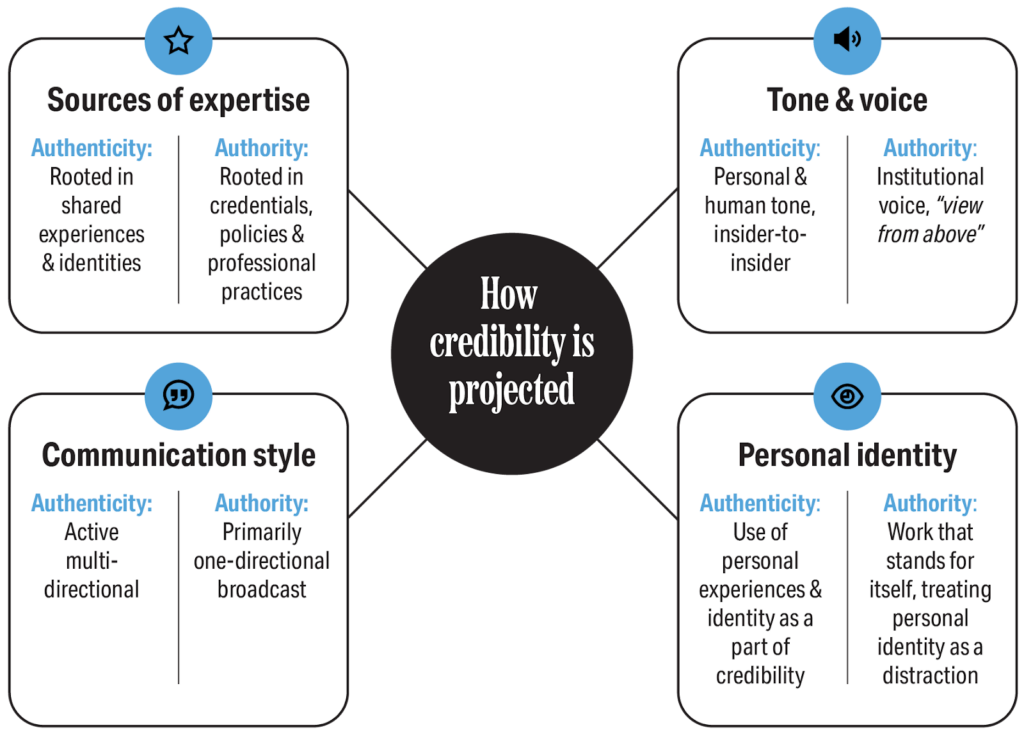
If legacy media idealizes the “view from above,” indie info providers reject it, taking on an “insider-to-insider” tone that starts with shared concerns and priorities.
Many interviewees critiqued the overly impersonal tone of “corporate” or “conglomerate” media and positioned themselves explicitly in contrast to it. Even those with a strong background in legacy media expressed this frustration. One person even described being discouraged from reporting on certain topics because of their personal background while working in legacy media even though their perspective could have been valuable.
Several participants linked the notion of authenticity with an observation that audiences prefer individual voices to institutional ones. “In a creator economy, the brand is you,” one told us. As another observed, “Humans trust humans. They don’t really trust brick walls. And so I try to show up in a very human way.” Strategies include adding occasional personal content or details, being “voicy” rather than relying on a dry institutional style, and spelling out the values and goals behind the reporting. All of these approaches allow indie info providers to distinguish themselves from other media outlets.
As the editor of a hyperlocal news site said, “We need to show people, ‘Hey, we are your neighbors. We are invested here.’ I am not owned by an out of state or out of country entity. I’m not owned by a billionaire. I’m just somebody who wants to contribute to this town and do a job that helps here.”
For the most part, indie info providers emphasize both authority and authenticity as elements of their credibility.
As the indie info providers described it, authenticity relies on being a community member and a “whole person,” while authority relies on credentials, institutions and professional processes.
Being an insider or community member could be a question of geography: one local news creator observed, “I don’t really see a reason to break down my credentials, degrees, all that stuff if no one is asking for that. And I also feel like it’s kind of elitist. … I was born and raised here. I’m not someone who is just popping up and saying I’m an expert on something about [this city] when I’m not from here. People know me.” It could be a question of professional identity: a B2B creator used this strategy, noting, “A lot of the communication of credibility for me occurs within the context of references and word choice. … It’s much more a performance of authenticity than a traditional media performance of credibility.”
There is no one-size-fits all approach. Several interviewees, including both former journalists and non-journalists, push back against the logic of authenticity entirely. One of them, whose project contains almost no personal content, observed, “I think that playing yourself on social media is exhausting. You reach a point where you’re at your limit. It’s also basically inviting people to scrutinize your personal life and your decisions in a way that, as a journalist, you don’t face nearly as much attention.” Another person hadn’t anticipated “that I would need to be as much of a present face in my community as I am currently” and finds it challenging.
The two most common ways indie info providers signal credibility via authority are by “showing your work,” often by citing or linking sources, and emphasizing their prior experience in journalism or other institutions.
Both former journalists and non-journalists emphasized showing the work, which makes conclusions traceable. It is also consistent with journalistic practice more broadly. “Everything I do is based on source documents. It’s not based on rumor or innuendo,” one person said. Transparency about funding, ethics policies and other institutional processes are another form of “showing the work” that is consistent with legacy journalism outlets. Former journalists and non-journalists alike highlighted this kind of transparency.
Meanwhile, some interviewees who emphasized their prior experience hoped that credibility would transfer automatically to them. One of these interviewees said that they signal credibility by “having bylines in legitimate news outlets” and another told us, “I post videos on TikTok and I always remind people I’m a journalist who’s been covering [this topic] for 25 years.” This strategy seems dubious given historically low U.S. trust in legacy media. In fact, many of those who rely almost exclusively on secondhand institutional credibility also have a hard time connecting with audiences.
If anything, our interviews suggest that authenticity is a must-have, while authority may be a value-add.
Indie info providers combine authentic audience engagement with authoritative rigor in communicating facts.
Unlike legacy newsrooms, where audience outreach and reporting are largely separate functions, indie info providers must handle both. In legacy newsrooms, journalists are typically asked to maintain an “impartial” stance in reporting, although they may use social media to attract audiences and engage with them. Typically, dedicated audience teams focus on attracting audiences, soliciting feedback and selecting stories with broad appeal. Indie info providers take on all of these roles themselves, leaving the boundary between audience engagement and reporting more porous than in legacy media.
They pay attention to audience responses to understand what resonates with them by asking for input or by following comments and interactions. One participant described attending networking events to get inspiration, observing, “If this person who fits the demographics of my audience has this question, then probably a lot of other people do as well.” Interviewees get ideas from direct messages from readers, and several send regular surveys or polls to understand their audiences’ interests and values. All of these ways of soliciting feedback would typically be covered by an audience engagement team in a legacy newsroom, where audience work is considered less central.
In a similar vein, indie info providers are responsive. They reply to emails, comments and DMs on social media. One even gave out their phone number. They attend events, livestreams and webinars, and several have a presence in audience Discord servers. This stands in contrast to many newsrooms where, for decades, reporters were instructed to avoid often-unregulated comment sections — in fact, many news organizations shut down comment sections years ago. Just three out of 26, all former journalists, said they do not engage with their audiences at all.
These more bidirectional relationships can have a dark side.
Interviewees expressed concerns over parasocial relationships and harassment. As they put it, the flip side of putting yourself and your personality into your work is that the audience feels like they know you. They may be more likely to pay to support your work because they feel a personal connection, but those relationships can be uncomfortable, and some people cross boundaries.
Multiple interviewees have dealt with hateful comments, personal attacks, threats or borderline defamation. One person recommended that would-be indie info providers develop a thick skin because “once you become public-facing, the amount of hate and the amount of personal and professional risk that you’re putting yourself out there by entering the arena is very real.” Others have developed systems to block specific words on their social media feeds and comments.
Deeper audience engagement does not always translate to more information about their audience.
Interviewees varied widely in how well they knew their audiences. Some could provide extensive demographics — often mentioning age range, geography, interests and gender. (All of these variables are included in standard analytics apps like Google Analytics.) On the other hand, fewer could speak confidently about the professions, race and ethnicity or income level of their audiences. In general, those who have an understanding of their audience use specific technology such as audience enrichment tools, sign-up surveys and analytics data.
But not all interviewees had concrete audience data. Some of them could make guesses based on email addresses or could infer their politics based on the tone of the content. Notably, five of the indie info providers who said that their work does not support their lifestyle at all also said they struggle to articulate their niche in terms of a concrete audience and that audience’s shared need. Some characterized their content as aimed at a specific age group or “regular people who like music.”
The legacy journalism connection
Credibility and audience relationships represent the area where we saw the strongest contrasts between legacy journalism institutions and indie info providers, even among those with journalism backgrounds.
For the most part, indie info providers rely on a personal tone that emphasizes shared experiences such as ethnicity, parenthood or community engagement — in addition to rigorous and transparent processes. In contrast, legacy journalism outlets tend to prefer a “neutral” voice that foregrounds the institution and leaves individuals in the background.
Most interviewees also engage closely with their audiences, bridging reporting and engagement. In legacy journalism, these tasks are often split between firewalled teams, with reporters discouraged from taking on direct audience work.
Continue Reading
Share