TL;DR
Explore Full Report
In South Africa, indie info providers include not just former and freelance journalists but also political satirists, subject matter experts and civic-minded community members building grassroots platforms. To begin to understand this professionally diverse group, we collaborated closely with Code for Africa, which has been mapping the country’s indie info provider landscape.
How and why we did this
Note on terminology
There is no consensus on terminology, even among our interviewees. We primarily use the term “indie info provider” and sometimes “creator-journalist,” which was the term used in our survey and interviews. Both terms appear throughout the report to refer to the same group: “people who are working to provide verified factual information with a personality- or voice-driven brand that leverages the creator economy.” That definition encompasses a tremendous amount of variation.
Why we did this
This is the second report in a two-country series about indie info providers.
According to our research, about one in four people in South Africa get news from individuals rather than organizations.
Moreover, the South African media environment is undergoing a profound transformation. Media crises in recent decades have led to “an increasingly constrained business environment,” forcing outlets to rely on freelance journalists and short-term contracts to stay afloat and leaving many journalists without stable employment. This shift has coincided with a massive migration in audience habits: recent surveys find that about 7 in 10 surveyed (online, English-speaking) South Africans get their news from social media, especially on their smartphones.
To date, research on this trend has largely focused on the broader landscape of content creators, including entertainers, politicians and other creators who do not necessarily focus on informing their audiences. And most research to date has focused on content sourcing and linking strategies. To enable a future for a plurality of fact-based sources that readers and viewers find relevant, our project sheds light on who indie info providers are and how they approach their role in the broader news landscape.
How we did this
In partnership with Code for Africa, CNTI recruited 43 content producers in South Africa to take a screening survey, 42 of whom met the eligibility criteria, and chose 18 of them for a 60- to 90-minute virtual interview. (The one who did not meet the criteria was neither South African-based nor working for a primarily South African audience.) CNTI selected interviewees to represent a range of professional backgrounds, such as project management and the military, beyond legacy journalism. This report is based primarily on insights from the interviews, with data from the survey as a secondary source.
In interviews, we asked participants about their backgrounds and motivations, audience engagement, their relationships with other indie info providers and legacy news outlets, platforms, and algorithms, revenue and business strategies, and their view of success and satisfaction with their own work.
We developed codes using a bottom-up iterative approach as themes emerged from the analysis. Code categories largely reflected the range of interview topics, as well as the addition of the broader theme “apartheid and historical context.”
These methods provide richness and depth; however, it’s not possible to generalize about the frequency of behaviors from these interactions, so we limit our use of quantitative terms to our interviewees throughout this report.
CNTI research and professional staff prepared this report. This project was made possible by the financial support of the Lenfest Institute and a second anonymous donor.
See “About this study” for more details.
More than half of the interviewees have previous journalism experience; those who don’t are building on previous careers and passions.
Most of the indie info providers in this study (11 of 18) have prior formal experience in journalism, whether as a freelancer or in a staff role. Of the other participants, four of them had worked in the arts and continue to do so and three had deep subject matter expertise that they parlayed into their work: for two, that expertise was professional, while the third writes about “topics that fed my soul from very young.”
Most interviewees coming from journalism backgrounds launched indie brands to navigate a precarious industry.
Seven of the 11 interviewees who had journalism backgrounds began their indie brands as freelancers. They were largely seeking to build their profiles, motivated by the decline in journalism opportunities in South Africa.
Many don’t necessarily distinguish between their freelance work and their indie brand; social media serves as a way to boost their freelance profile and continue getting contracts from legacy media. One interviewee said, “As a freelancer… I’ve never really been able to rely on a publication to push my work … social media for me, initially, was just on my personal Instagram where it was mostly people I knew.” Others described social media as only indirectly monetizable: having a growing public profile has led to offers of paid work.
When that hasn’t been effective, indie info providers have started figuring out how to monetize social media directly. One interviewee began a self-funded project after their freelance work dried up and they felt that the journalism world was “collapsing.” They continue to pitch their work to publications while also sharing it online, but they stated that they cannot depend on assignments from publications to cover their expenses.
This reliance on social media to maintain a flow of opportunities reflects the reality of the South African media environment for journalists, specifically the gig-ification of journalism work. While labor and economic precarity came up in most interviews, only a few individuals mentioned the role of structural factors like race and location, and it wasn’t a question we specifically asked.
While the term “journalist” resonates with many interviewees, some feel the term is too limited. They see “creators” as distinct from “journalists.”
Interviewees lack a unified preference for professional titles, though many gravitate toward journalistic terminology, even if they don’t have a background in the field. When asked what professional title they use on the pre-interview survey, most interviewees offered not just “journalist” but “producer,” “editor,” “publisher” and variations on those titles. On the same survey, 11 of the interviewees said they consider themselves journalists, while seven said, “It’s complicated.” A few feel the term “journalist” encompasses a small portion of everything they do. Not only do they produce journalistic content for their indie brands, they also serve as entrepreneurs, social media managers, salespeople, researchers, engagement teams and more. As one political satirist explained,
I’m a new media creator who talks about the news and delivers news to people, so in a very simple way, I am a journalist. But I do it through wide-ranging media reading and consumption of information. I do lots of online data research. … I’m definitely doing journalism but in South Africa with our investigative journalists and our frontline beat journalists it feels odd to put me in that category.”
Still, for some, “journalism” feels confining as a label. One interviewee likes the freedom to combine their personality with their work online, instead of feeling that they have to choose between their interests. Now, with their indie brand, they can address a broader range of topics: “I love journalism, but I’ve never really identified as a journalist. I have so much more to talk about. Firstly, I’m not that into politics, honestly. And it feels like politics and journalism, at least in South Africa, are so intertwined as almost one thing. If you’re a journalist, you’re talking about politics.” This is consistent with previous research showing that the public largely defines the terms “news” and “journalism” somewhat narrowly around current events.
Some South African interviewees consider themselves “creators,” but they see this role as distinct from journalism. At least one person sees becoming a creator as largely positive, an opportunity to expand their professional toolkit. “I felt like I’d be very limited if I only had journalism as a skill,” they said. Others are much more negative about the term, like one interviewee who differentiated creators from “serious people.”
The relative comfort with journalistic titles is consistent with public attitudes, since the South African public generally holds a positive perception of journalists. According to CNTI’s 2024 public survey, 76% of South Africans think that news organizations are a critical part of an informed society. Further, as of 2025, 55% of the South African public trusts news overall, the fifth-highest ranking in the 48-country study.
Deep dive: Some indie info providers distinguish themselves with expansive professional identities as artists, activists, academics and more.
Several interviewees define themselves as spanning multiple fields, with journalism and content creation as just one small aspect of their professional identity. For example, one person said in the screening survey that they use the title “journalist” yet responded “it’s complicated” when asked if they consider themself a journalist. As they explained in the interview, the field of journalism is in constant change, and they are “straddling academia and … journalism.” Another interviewee rejected the journalist label and instead uses the title public relations officer: “I’m not a journalist. I’m definitely a public figure. I’m definitely a leadership figure. I’m definitely an orator. I’m definitely a spokesperson.”
Some of these interviewees are members of the Rastafarian Movement, a decentralized faith and culture that gained momentum in Jamaica in the 1930s, spread informally in South Africa during apartheid and was introduced formally in South Africa in the 1990s. During the 1970s and 80s, South African Rastafarians were mostly unemployed black youth with an average age of 26 and low education rates. Since the end of apartheid, the movement has grown and includes school and university students, white South Africans and professionals. Its political philosophy largely reflects pan-African ideology, critiquing and analyzing Western society. A central tenet of the culture is the importance of community gathering and this philosophy is evident in the interviewees’ approaches to their work. This orientation toward community may shape how these interviewees perceive their roles in the indie info provider space.
Across the South African interviewees, they see their personal and professional identities as connected (see “historical context”).
Interviewees define success as fulfilling their mission to inform while building financial sustainability.
For many interviewees, success includes both mission- and business-related goals — not one or the other. As one interviewee put it, “Success looks like making a thriving living, not a surviving living, off of actually solving the problems I want to solve.”
Mission-related goals often align with concerns about the state of journalism in the country. As one interviewee stated, they will feel successful when they can employ other journalists, help others do what they love and “show that journalism isn’t dead. There is still something behind it.” Another interviewee’s perspective on success underscores their worries about the exclusion of certain news stories and narratives. They want their work to be “visible” above all else because, “These stories are important. These stories are about people who are invisible in the public discourse. They are people that are ignored, whose suffering is ignored by rich wealthy people whose comfort comes at the expense of those who are suffering the most.” These responses echo larger trends. Specifically, the decreasing number of journalists and the decline in industry funding have led to fewer stories, particularly nuanced stories from local reporters.
While both topics came up across every interview, some interviewees spoke primarily about measuring success by one metric or the other. In particular, those who highlighted only mission-related goals were largely subsidizing their own indie brands or making major financial sacrifices to continue doing this work.
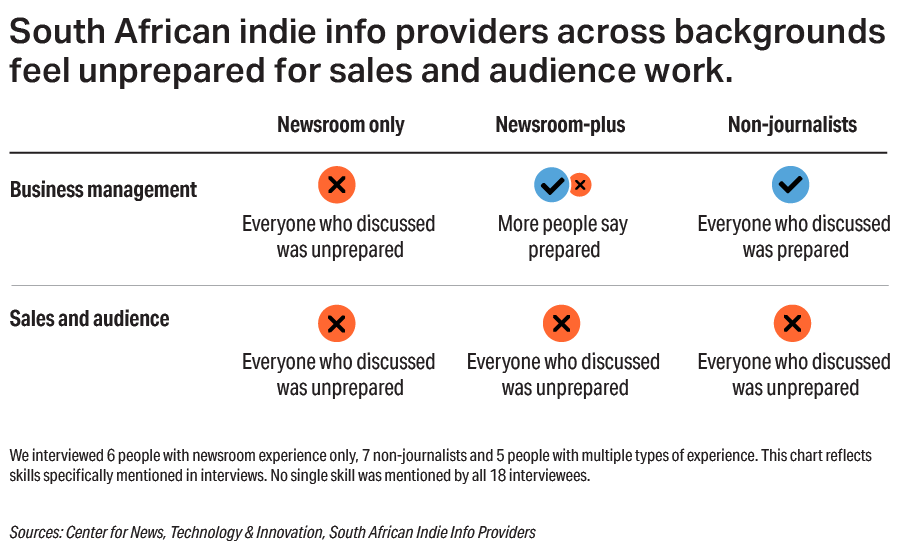
Most interviewees who felt prepared to manage a business drew that confidence from prior experience outside of journalism.
Interviewees expressed a lack of preparation for sales and audience-building tasks, while they were more mixed about business management skills. Those who felt ready for the business side of their project had experience outside of journalism and said that previous jobs had equipped them with the business skills needed for their project. Of these interviewees, several had no journalism background. One had worked as a project manager, another as a CEO and a third in labor relations and strategy. A fourth interviewee explained that they used their time in the newsroom to learn the business side, but had also worked in other ventures.
Interviewees who mentioned their journalism school experience expressed that they were ready for the reporting side of journalism — but not for running a business. This finding is to be expected: South African journalism schools, like others around the world, do not prepare their student journalists to be freelancers or to run a business. Instead, these programs focus on preparing their students for a career in the newsroom, a future that might not be a reality for most graduates.
The only interviewee who mentioned feeling unprepared for journalism-related tasks had recently transitioned from another career. They struggled with the realities of on-site reporting, saying, “When you come from an office environment, you realize as much as it’s the most exciting thing about journalism, going on site, wading through the Blyde River with crocodiles there, that’s an experience that you can’t prepare for.” This unpredictability was compounded by a lack of logistical support. As a newer indie info provider, they felt the lack of infrastructure for freelancers, identifying difficulty with “the mobility, the logistics of it, figuring out how to do things. Unless you are well established [and] you have all of this at your fingertips. The guys that are just beginning or just starting off, there isn’t much support on that side.” These issues are not unique to freelance journalism: Freelancers across industries are likely to face similar challenges, especially the feeling of being unsupported by institutional structures.
What the U.S. can learn from South Africa
South African interviewees move fluidly between freelance work and their indie brands, seeing each as creating opportunities for the other. On the other hand, many U.S. interviewees turned to both only after losing full-time jobs, and largely see the two in conflict with each other. South African interviewees weigh mission and financial sustainability somewhat more equally than those in the U.S., who prioritize mission. A broader understanding of the interconnectedness of all independent work may help alleviate some of the pressure U.S. indie info providers feel around making their work directly profitable.
Continue reading
Share