TL;DR
Explore Full Report
Overview
As of September 2024, about one in four people in South Africa get news from individuals rather than organizations. In a mobile-first country where more than four in five residents say digital technology is “very important” for staying informed, social media platforms have become vital news sources for South Africans. Though some evidence suggests news creators (i.e., indie info providers) are less popular in South Africa than in many other countries, the data points to a clear trajectory that aligns with the global trend of personality-led journalism and the rapid rise of new entrants.
About this study
Note on terminology
There is no consensus on terminology, even among our interviewees. We primarily use the term “indie info provider” and sometimes “creator-journalist,” which was the term used in our survey and interviews. Both terms appear throughout the report to refer to the same group: “people who are working to provide verified factual information with a personality- or voice-driven brand that leverages the creator economy.” That definition encompasses a tremendous amount of variation.
Why we did this
This is the second report in a two-country series about indie info providers.
According to our research, about one in four people in South Africa get news from individuals rather than organizations.
Moreover, the South African media environment is undergoing a profound transformation. Media crises in recent decades have led to “an increasingly constrained business environment,” forcing outlets to rely on freelance journalists and short-term contracts to stay afloat and leaving many journalists without stable employment. This shift has coincided with a massive migration in audience habits: recent surveys find that about 7 in 10 surveyed (online, English-speaking) South Africans get their news from social media, especially on their smartphones.
To date, research on this trend has largely focused on the broader landscape of content creators, including entertainers, politicians and other creators who do not necessarily focus on informing their audiences. And most research to date has focused on content sourcing and linking strategies. To enable a future for a plurality of fact-based sources that readers and viewers find relevant, our project sheds light on who indie info providers are and how they approach their role in the broader news landscape.
How we did this
In partnership with Code for Africa, CNTI recruited 43 content producers in South Africa to take a screening survey, 42 of whom met the eligibility criteria, and chose 18 of them for a 60- to 90-minute virtual interview. (The one who did not meet the criteria was neither South African-based nor working for a primarily South African audience.) CNTI selected interviewees to represent a range of professional backgrounds, such as project management and the military, beyond legacy journalism. This report is based primarily on insights from the interviews, with data from the survey as a secondary source.
In interviews, we asked participants about their backgrounds and motivations, audience engagement, their relationships with other indie info providers and legacy news outlets, platforms, and algorithms, revenue and business strategies, and their view of success and satisfaction with their own work.
We developed codes using a bottom-up iterative approach as themes emerged from the analysis. Code categories largely reflected the range of interview topics, as well as the addition of the broader theme “apartheid and historical context.”
These methods provide richness and depth; however, it’s not possible to generalize about the frequency of behaviors from these interactions, so we limit our use of quantitative terms to our interviewees throughout this report.
CNTI research and professional staff prepared this report. This project was made possible by the financial support of the Lenfest Institute and a second anonymous donor.
See “About this study” for more details.
The group was primarily drawn from Code for Africa’s broad network, which was built through targeted mapping, continent-wide surveys and the MediaData database. In addition, snowball sampling was employed during the survey, which means that interviewees played an active role in defining who to include, and some participants may come from outside Code for Africa’s network. Among this set of South African indie info providers interviewed, we learned that:
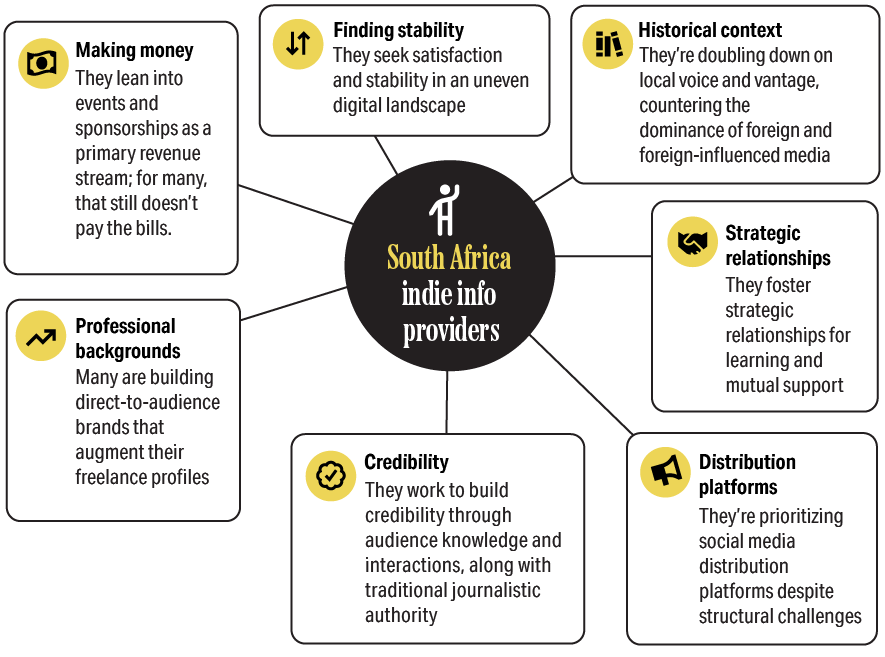
💼 Many are building direct-to-audience brands that augment their freelance profiles.
Most interviewees (11 of 18) had journalism backgrounds, and most of those (seven of 11) had been freelancers at some point during their careers. In the face of decreasing journalism opportunities, they launched indie brands to attract more freelance work. That means they don’t necessarily draw a clear line between work for others and for their own brand. While the term “journalist” resonated with many interviewees, some found it too limiting and they drew a distinction between “creators” and “journalists.” Like their U.S. counterparts, they’re driven by a desire to inform people — and many define success as fulfilling that mission while building financial sustainability. The interviewees who felt prepared to manage the business side of their ventures attributed their skills to prior experience outside of journalism, not journalism school or formal training.
📜 They’re doubling down on local voice and vantage, countering the dominance of foreign and foreign-influenced media.
For interviewees, questions of social privilege and power shape how stories are told and who is seen as entitled to tell them. In fact, many see their identity as a key part of their branding. This cohort of interviewees raised concerns about ongoing dependence on foreign coverage, which is short on local stories for local people and tends to be overwhelmingly negative. In response, they see themselves as “decolonizing” local media and offering a “solutions mindset,” which are intertwined. (In contrast, their U.S. counterparts did not situate their work in a larger global context at all.)
🗣️ They foster strategic relationships for learning and mutual support.
South African interviewees have expansive networks, encompassing not only professionals but also family and personal connections that play a meaningful role in supporting their work. They rely on “relationships where you can either learn or grow together.” Driven by resource scarcity and the need for growth, most leverage a mix of formal and informal partnerships to sustain operations, expand audiences and combat professional isolation. This extends to ongoing relationships with newsrooms: many indie info providers maintain collaborative ties as freelancers, allowing them to contribute to legacy outlets while sustaining independent projects. (Their U.S. counterparts, on the other hand, were less successful in developing relationships with newsrooms.)
🤝 They work to build credibility through audience knowledge and interactions, along with traditional journalistic authority.
South African interviewees draw on direct audience feedback, overall metrics from social media platforms and story-specific engagement data to maintain a relatively clear sense of who they reach. (As a group, they had more sophisticated audience knowledge than their U.S. counterparts.) Audience feedback is generally seen as generative and valuable, if sometimes overwhelming. Still, “showing up” for the audience online and in-person is a key component of building and sustaining credibility: “It’s not a situation where I can establish credibility from on high … so it was always going to be about getting on the ground with people and getting into the nuance and the details.” At the same time, South African interviewees also aim to build trust via traditional markers of journalistic authority, particularly through rigorous sourcing, verification and fact-checking practices.
📊 They’re prioritizing social media distribution platforms despite structural challenges.
Reflecting the country’s high mobile phone adoption rate and widespread social media use, most South African interviewees rely heavily on social media over newsletters and websites. Even within the social media space, interviewees diversify their presence to hedge against changes in visibility and reach, shadowbanning and overmoderation — a strategy shared with their U.S. counterparts. These challenges are further compounded by misogyny and racism online, where indie info providers, especially Black women, face coordinated mass reporting campaigns when addressing sensitive social issues.
💸 They lean into events and sponsorships as a primary revenue stream; for many, that still doesn’t pay the bills.
More than half of South African interviewees described financial sustainability as one of their biggest obstacles, with six of 18 making no meaningful income and at least seven of 18 effectively sponsoring their own work in “this loss-making entity called journalism.” Some adopt an ineffective “build it and they will come” approach, while other interviewees tend to rely on diversified revenue streams. Specific sources of revenue also differ from the U.S.: Events play a central role in many business models for South African indie info providers, building credibility and audience while also generating revenue. By contrast, subscriptions and memberships are widely seen as less viable, and traditional advertising is less common than sponsorships, advertorials and other forms of “spon-con.” While grants are part of the ecosystem, they are not viewed as sustainable or predictable sources of support. Across approaches, there is a strong awareness of the ethical implications and trade-offs of outside financing.
⚖️ They seek satisfaction and stability in an uneven digital landscape.
Most interviewees (12 of 18) started their businesses before 2020. While their U.S. counterparts are in the earliest stages of entrepreneurship, South African interviewees have the foundations largely figured out. They enjoy their work and take great pride in it, but financial uncertainty and stress are taking a toll on their happiness. While many established interviewees now maintain standard working hours, that does not necessarily translate to job satisfaction, as many continue to struggle to balance the pressures of growth and day-to-day operations. At the same time, interviewees and the South African public at large express cautious optimism about generative AI’s potential to help manage resource-strained newsrooms. In practice, the effectiveness of this technology is frequently limited by cultural biases, linguistic gaps and unreliable internet infrastructure, particularly in rural areas. Reflecting South Africa’s digital divide, indie info providers are often running sophisticated, cloud-based AI tools on fairly basic hardware.
Acknowledgments
Thank you to Code for Africa and Liz Kelly Nelson for input throughout this process; Nechama Brodie and Sarah Chiumbu for their thoughtful feedback on this report; Jonathon Berlin and Kurt Cunningham for web and graphic design; Grace Nuri for support with transcription and data processing; and Greta Alquist for editing this report. This project was made possible by the financial support of the Lenfest Institute and a second anonymous donor. We thank all the creators who participated in this report.
Continue reading
Share